How Conservation Easements Shape Chester County Property Value
September 3, 2026
September 3, 2026
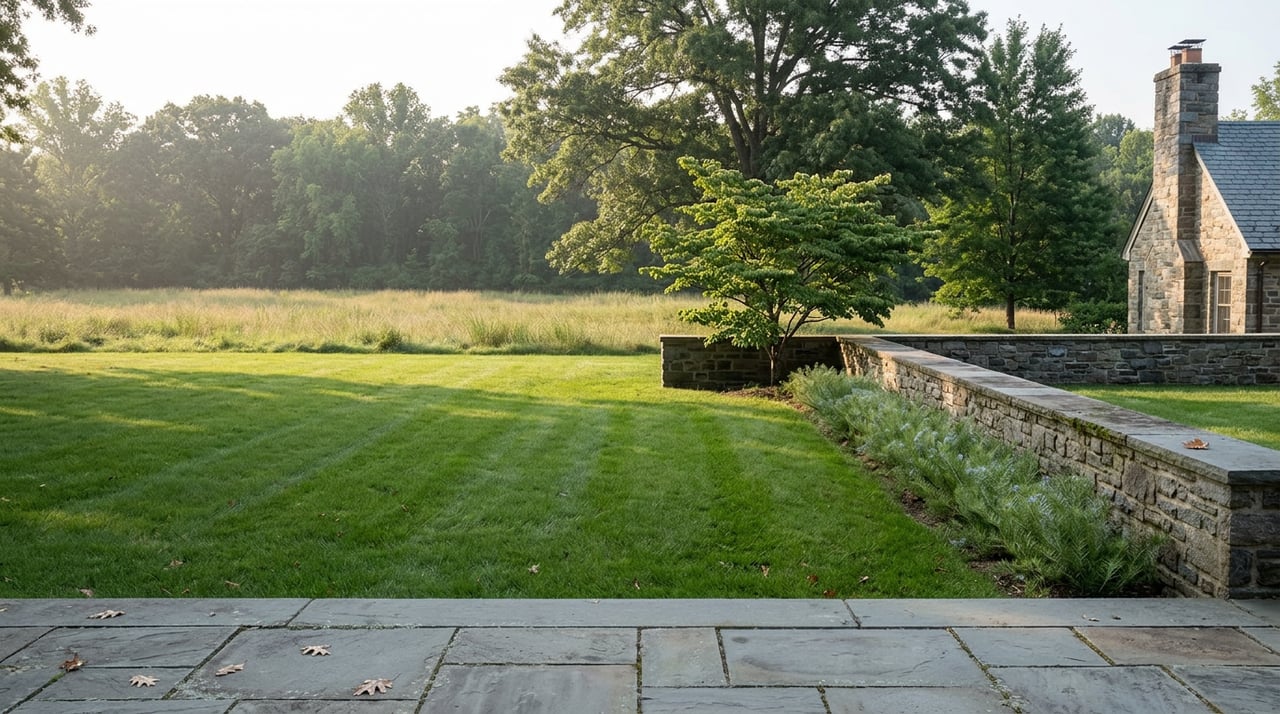
This spring, Willistown Township notified a Malvern landowner named Dr. Richard Glunk that it intended to take a 2,060-square-foot strip of his property along Spring Road. The stated reason was a failing culvert and years of stormwater flooding that the township wanted to fix. The complication is that Glunk's land, a 45-acre farm called Maple Leaf Farm that has been worked since the 1700s, sits under a conservation easement held by the Brandywine Conservancy and is enrolled in the township's Agricultural Security Area. Glunk appealed to the Chester County Board of Commissioners, arguing the project would damage land that was supposed to be permanently protected. The township held a public hearing on June 4 to consider moving forward anyway.
Whatever the outcome, the dispute exposes something buyers evaluating estate-scale land in Chester County rarely stop to ask: protected from what, exactly, and by whom? The county's countryside is dotted with the word "preserved," but that single word covers at least three legal arrangements with very different levels of permanence, and confusing them is one of the more expensive mistakes a buyer can make when the whole reason for paying a premium is the assumption that the fields next door will stay fields.
A conservation easement, an Act 319 Clean & Green enrollment, and an Agricultural Security Area designation get used almost interchangeably in casual conversation about Chester County land. They are not the same instrument, and they don't offer the same guarantee.
A recorded conservation easement, the kind held by the Brandywine Conservancy, Willistown Conservation Trust, Natural Lands, or The Land Conservancy for Southern Chester County, is a permanent restriction attached to the deed. It runs with the land regardless of who owns it, and the holding organization conducts annual monitoring visits to confirm the terms are being honored. This is the strongest form of protection available to a private landowner.
Act 319, better known as Clean & Green, is something else entirely: a tax election, not a land-use restriction. A landowner enrolls at least 10 acres in agricultural, agricultural reserve, or forest use and gets taxed on that use value instead of fair market value, often a substantial savings. But the owner can walk away from the program at any time. Breaking the covenant triggers a rollback tax, up to seven years of the tax difference plus 6 percent annual interest, and the land can then be sold for development. An owner can also split off up to 10 percent of the enrolled acreage, capped at 10 acres total and 2 acres a year, without leaving the program.
An Agricultural Security Area is narrower still. Enrollment shields a working farm from nuisance complaints about normal farm operations, and it happens to be a prerequisite for applying to the county's easement purchase program. It does not, by itself, prevent the land from ever being developed.
| Instrument | Who holds it | Reversible? | What it actually guarantees |
|---|---|---|---|
| Conservation easement | Land trust or conservancy (Brandywine Conservancy, Willistown Conservation Trust, Natural Lands, TLC for Southern Chester County) | No, runs with the deed permanently | No private development, monitored annually |
| Act 319 / Clean & Green | Chester County Assessment Office | Yes, with a rollback tax penalty | Lower property tax while enrolled, nothing after exit |
| Agricultural Security Area | Township | Yes, at township discretion | Farm-nuisance protection, no development guarantee |
Maple Leaf Farm carries the top tier of protection, a recorded easement plus ASA enrollment, and the township is still moving forward with condemnation for a narrow strip. That's not a contradiction so much as a boundary condition worth understanding before you pay for adjacency to preserved ground. Conservation easements are built to block private development and subdivision. They are not designed to override a municipality's authority to take a small parcel for public infrastructure or safety, which is a different category of taking than a developer buying out a farm.
For a buyer, the practical distinction is this: an easement protects you from the field next door becoming twelve townhouses. It does not protect you from a road department needing eight feet of frontage for a culvert.
Chester County's land market attracts several buyer types bidding on overlapping ground for different reasons: working farmers looking at tillable soils in the western part of the county, equestrian buyers concentrated around Unionville and West Marlborough who will pay a real premium for confirmed horse-farm character nearby, preservation-minded buyers willing to pay for easement-eligible ground itself, and Main Line-adjacent lifestyle buyers who tend to pay the highest per-acre prices of any group. Four different buyers can look at the same 50-acre parcel and arrive at four different valuations, because each is paying for a different promise about what the surrounding countryside will look like in twenty years.
Small-acreage premiums swing just as widely at the low end. A 4.5-acre farmette in Honey Brook reportedly closed privately earlier this year at $655,000, a number that only makes sense once you know what kind of buyer was competing for it and what assurance came with the parcel. Per-acre averages are close to useless for pricing an individual property. What moves the number is soil quality, road frontage, Clean & Green status, and whether the surrounding acreage is locked in permanently or simply enrolled in a tax program that could unwind.
This is where the county's own preservation record matters to a buyer's due diligence. In 2024 alone, Chester County's combined agricultural and open-space programs permanently protected more than 1,240 acres, including the 204-acre Crebilly Preserve acquisition in Westtown Township and a 156-acre parcel in West Bradford Township tied to the Embreeville property. Willistown Conservation Trust's Kestrel Hill Preserve, an 89-acre addition, is on track to become publicly accessible. A few years earlier, in 2023, Willistown Conservation Trust worked with a private buyer, director M. Night Shyamalan, to permanently conserve 90 acres of the Kirkwood Farm property in the same township. Deals like these are recorded, monitored, and irreversible. They are a genuinely different asset than a neighboring parcel sitting in Clean & Green, which could, in theory, be pulled from the program next year if the owner decides the rollback tax is worth paying.
If a listing description leans on phrases like "surrounded by preserved farmland" or "borders open space," the useful follow-up question is which category that neighboring land falls into. A title search or a call to the Chester County Assessment Office can confirm whether adjacent parcels carry a recorded easement, sit in Clean & Green, or are simply zoned agricultural with no restriction attached at all. For a buyer paying a premium specifically for that open view, the difference between permanent and reversible is the difference between a locked-in feature and a temporary one.
The same logic runs the other direction for sellers of estate-scale property that itself carries any of these designations. A recorded easement is a selling point you can state with confidence. A Clean & Green enrollment is a tax benefit worth disclosing clearly, along with what a buyer would owe if they ever changed the use. Buyers increasingly know to ask, and a seller who can answer precisely, rather than gesturing at "preserved," closes with fewer surprises at the table.
Does a conservation easement transfer automatically when a property sells? Yes. It's recorded against the deed and binds every future owner, not just the person who granted it.
Can preserved land still be taken through eminent domain? The Maple Leaf Farm dispute suggests yes, for narrow public infrastructure purposes, even when the land carries a recorded easement and Agricultural Security Area status. Easements block private development, not a municipality's separate legal authority to take land for public projects.
If I buy land enrolled in Clean & Green, do I inherit the tax benefit and the risk? Both. You'll continue receiving the use-value assessment as long as you maintain the qualifying use, but if you later convert the land, you become liable for the rollback tax based on the enrollment period, up to seven years, plus interest.
Is Agricultural Security Area enrollment the same as permanent protection? No. It's a prerequisite for applying to the county's easement purchase program and a shield against nuisance complaints for working farms. On its own, it doesn't stop a future sale for development.
If you're weighing an estate-scale property in Chester County and the pitch includes open acreage next door, it's worth finding out exactly what's holding that ground open before the number on the listing sheet starts to feel like a promise. The Megan Van Arkel Team works this exact terrain across the Main Line and Chester County and can walk you through what's actually recorded against a property, and what isn't, before you write an offer. Get Your Home Value.
Stay up to date on the latest real estate trends.

The Megan Van Arkel Team is dedicated to helping you find your dream home and assisting with any selling needs you may have. Contact them today to start your home-searching journey!