How Chestnut Hill's Two Train Lines Compare Going Into 2027
November 19, 2026
November 19, 2026
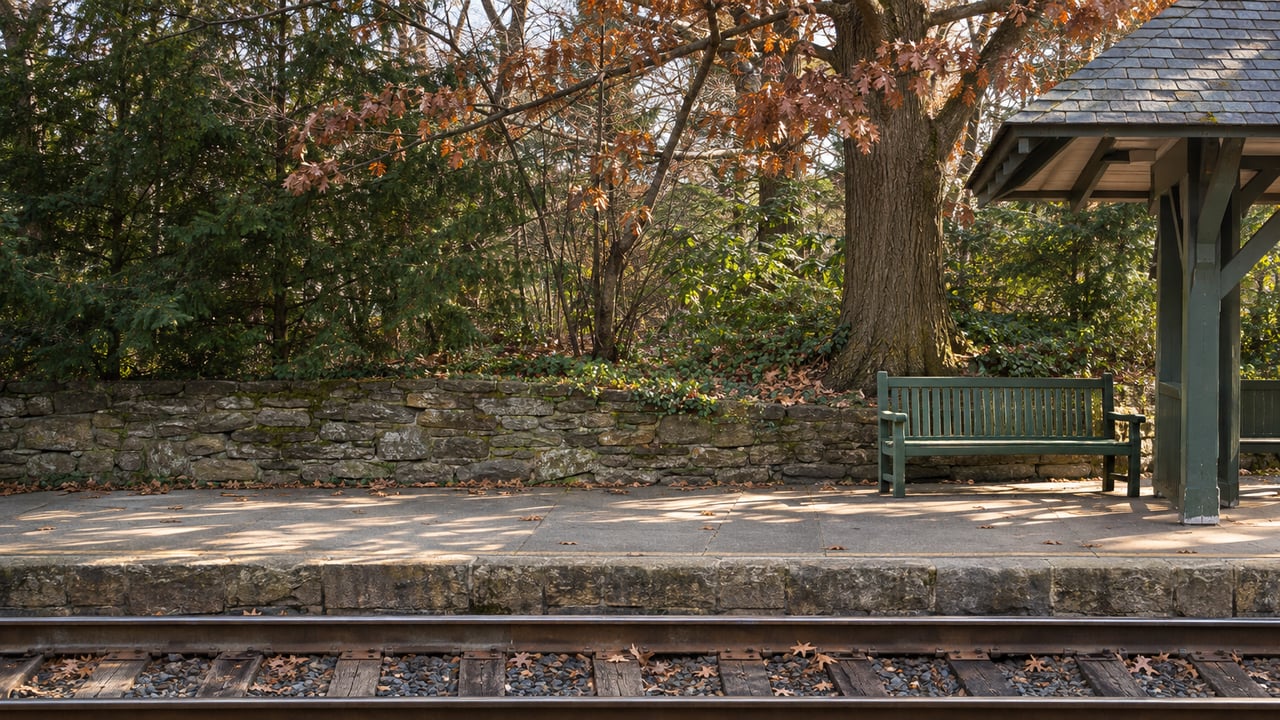
Chestnut Hill Avenue meets Bethlehem Pike at the east edge of the neighborhood. Since Monday, October 12, riders there have boarded from a new high-level accessible platform at Chestnut Hill East Station, and construction crews are still at work around them. Across the hill, the Chestnut Hill West terminal stands at Germantown and West Evergreen avenues, steps from the neighborhood's main business corridor. Few neighborhoods in Philadelphia have two Regional Rail terminals, and buyers comparing streets here often treat the two lines as interchangeable.
On this fall's timetables they nearly are. The difference lies in what happens next. One line has a rebuilt station and a central place in SEPTA's draft plans for more service. SEPTA has identified the other as likely one of the first Regional Rail cuts if its funding gaps persist. For anyone deciding between the east and west sides of Chestnut Hill this winter, the train question depends on when you need the train, and the answer will come out of the state budget debate in 2027.
SEPTA's current Chestnut Hill East timetable, effective October 18, 2026, lists 20 weekday trains from the terminal to Center City and 21 back. The Chestnut Hill West timetable, effective July 5, 2026, lists 21 weekday trips in each direction. Both lines run roughly hourly outside the morning peak, with trains closer together in the morning.
| Chestnut Hill East | Chestnut Hill West | |
|---|---|---|
| Terminal address | 100 E. Chestnut Hill Avenue | 8606 Germantown Avenue |
| Other stops on the timetable near the neighborhood | Gravers, 300 E. Gravers Lane; Wyndmoor, 246 Wyndmoor Street | Highland, 8452 St. Martins Lane; St. Martins, 320 W. Willow Grove Avenue |
| Weekday trains to Center City, current timetable | 20 | 21 |
| Terminal to Jefferson, representative trip | About 36 minutes | About 42 minutes |
| Terminal to Suburban, representative trip | About 41 minutes | About 37 minutes |
| Weekend and major holiday trains each way | 9, about every two hours | 9, about every two hours |
The routes split before they reach downtown. The East line gets to Jefferson Station a few minutes sooner, and the West line gets to Suburban Station a few minutes sooner. Beyond that, the daily ride gives little reason to choose one side of the hill over the other right now.
SEPTA's reconstruction of Chestnut Hill East began in January 2025. According to SEPTA's station improvements page, the work includes a new high-level accessible platform, accessible restrooms, new lighting, signage and seating, building repairs, new platform roofing, and a stormwater system designed to hold 130,000 gallons. Trains are running normally. The project's leftover effects are mostly about parking. SEPTA's current notice limits parking to 18 spaces on East Chestnut Hill Avenue next to the South Lot, including one ADA space, and bars overnight parking until construction is finished. The North Lot is closed for stormwater and restoration work until further notice.
SEPTA had targeted fall 2026 to finish the work, and its capital program lists the project as running from 2025 through 2027. A buyer who plans to drive to the East terminal and park should expect tight parking for at least the next few months. Buyers who can walk to the platform won't be affected.
The East line's bridges have also had attention. In summer 2025, SEPTA suspended the line to rehabilitate five bridges at Wayne Avenue, Logan Street, Chew Avenue, Mt. Pleasant Avenue and Cresheim Valley Drive. On the West line, SEPTA's capital budget schedules construction on seven bridges from 2025 through 2028, rehabilitating three and replacing four, including those at Carpenter Lane and Springfield Avenue.
As the Chestnut Hill Local's rail history recounts, the West line was built to serve the planned St. Martin's community around the Philadelphia Cricket Club and the Church of St. Martin-in-the-Fields. Today it has three stops in Chestnut Hill and ends at the top of Germantown Avenue. It has also been the line at the top of SEPTA's list of cuts more than once.
In April 2025, as the Chestnut Hill Local reported, SEPTA's FY2026 proposal made Chestnut Hill West one of five Regional Rail lines to be eliminated on January 1, 2026. That proposal sat inside a 45% systemwide service reduction meant to close a forecast $213 million deficit. SEPTA's board approved that budget in June 2025 and kept the January elimination unless lawmakers provided new funding. The cut did not happen. In September 2025, according to WHYY, the Shapiro administration and PennDOT authorized SEPTA to move up to $394 million of capital money into operations, and service returned to its pre-cut schedule.
SEPTA's stated reasons for choosing the West line have been consistent. The agency screened lines on ridership, redundancy and equity. In January 2024, the Local reported that SEPTA pointed to the Chestnut Hill East line and the Route 23 bus as other ways for West-line riders to get downtown. WHYY reported SEPTA performance data showing 20 passengers per hour and an operating cost of $19.60 per passenger on Chestnut Hill West in 2025. Ridership alone doesn't explain the choice. The Inquirer reported SEPTA's 2022 weekday averages as 1,752 riders on Chestnut Hill West and 1,573 on Chestnut Hill East, which ranked them 11th and 12th of 13 lines. The two lines carry similar numbers of riders. Because the East line is there, SEPTA treats the West line as the one Chestnut Hill could lose and still have rail service.
The neighborhood has organized around the West line. According to the Local, Save the Train began as a coalition of Northwest Philadelphia civic groups led by organizer Anne Dicker. Its volunteers held "ride and rallies" at stations, ran a funding petition and surveyed riders. By February 2024, the Local reported, the coalition counted more than 50 civic groups, 200 volunteers, 7,000 petition signatures and about 12,000 survey responses.
The Chestnut Hill Local reported on November 11 that SEPTA has identified Chestnut Hill West as likely one of the first Regional Rail cuts if funding gaps persist. The current West timetable still lists full weekday and weekend service.
Service is set through June 2027. SEPTA's FY2027 budget, announced June 25, 2026, includes no service-level changes and no fare increases. That budget depends on the second and final year of the $394 million transfer, and SEPTA says its longer-term future is uncertain without state funding. The Inquirer reported on November 13 that the transferred money runs out next summer and that SEPTA projects a $192 million structural operating deficit next year.
The November 3 election changed the odds. Democrats flipped the state Senate, so starting in January they will hold the governorship and both legislative chambers. The Inquirer described that as better prospects for a transit funding bill, though not a guaranteed deal. Gov. Josh Shapiro has pledged "we will fund transit" without saying how, and the options discussed so far include taxing skill games or legalizing recreational cannabis. SEPTA general manager Scott Sauer told The Inquirer he did not see Democratic control as "some cakewalk." Locally, state Sen. Art Haywood, re-elected in the 4th District, told the Local that closing the gap "will take a multi-year approach."
SEPTA is now making its funding case by describing the service it would add with the money. Its 10-year Accelerate blueprint calls for Regional Rail trains every 15 minutes on critical lines in the city and the closest suburbs. The vision chapter of SEPTA's Regional Rail master plan, still marked as a draft, puts the two Chestnut Hill lines in different tiers. Chestnut Hill East is paired with Wawa as an "S2" line. The plan forecasts its ridership growing 212% over 2019 levels, with weekday departures increasing 1.75 times over 2019 and weekend departures nearly three times over 2019. Chestnut Hill West appears in the "Regional" tier, whose service standard is a maximum wait of 60 minutes. SEPTA's long-range thinking matches its short-term cut list: if the system grows, its plans put that growth on the East line.
For a buyer, the two lines differ most in timing. Through June 2027, both run on nearly the same schedule, and the West line keeps its advantage in walkability: its terminal is at the top of Germantown Avenue, and its Highland and St. Martins stations are on St. Martins Lane and West Willow Grove Avenue. After that, the West line depends on what Harrisburg passes. The East line has a rebuilt terminal, parking that is tight until construction ends, and the larger role in SEPTA's draft plans.
A buyer who needs a daily train to Center City for years should weigh those timelines alongside the house itself. A buyer who rides now and then, or who would accept the Route 23 bus or the East line as a backup, has less at stake in the outcome. For readers moving from downtown, our earlier guide to relocating from Center City to Chestnut Hill covers the rest of that move. Our Chestnut Hill neighborhood page gives a wider view of the housing on both sides of the hill.
If your Chestnut Hill search depends on which station a house is near, Megan van Arkel and our team are glad to talk through how the homes you're considering sit relative to both lines before you write an offer. Reach out to start the conversation.
Stay up to date on the latest real estate trends.

The Megan Van Arkel Team is dedicated to helping you find your dream home and assisting with any selling needs you may have. Contact them today to start your home-searching journey!