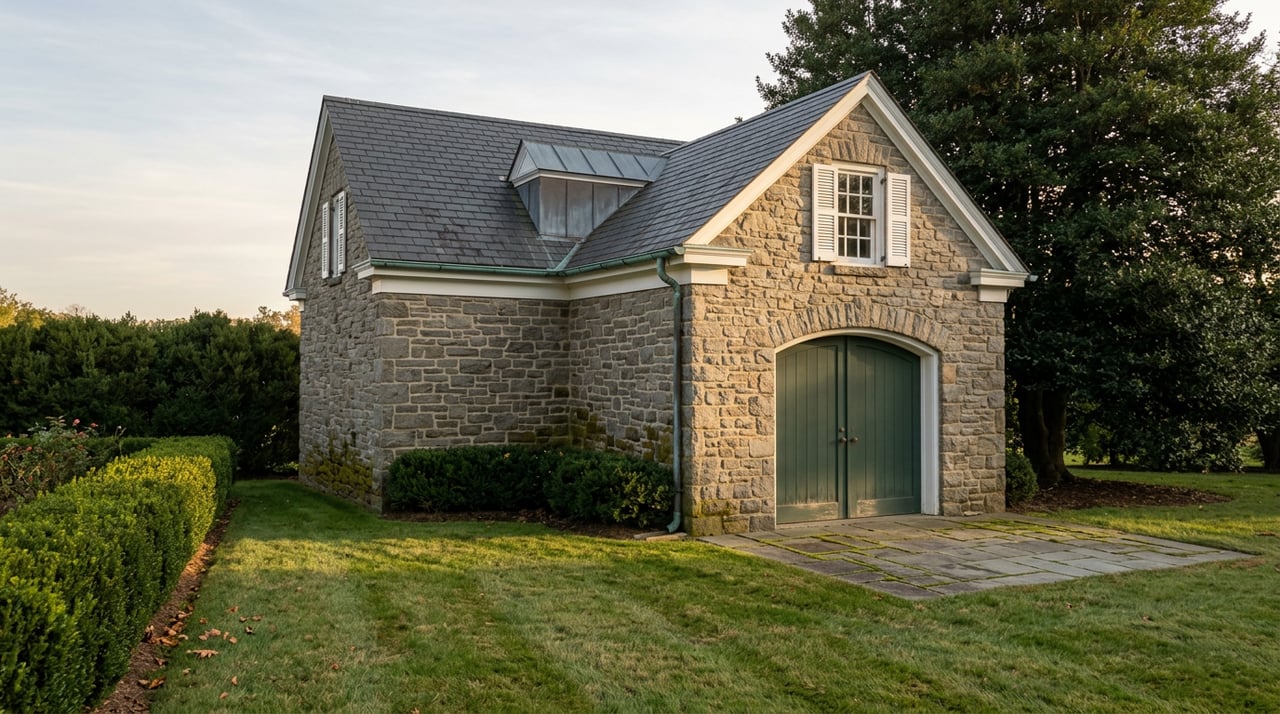
In Chestnut Hill, the Carriage House Isn't a Second Home Until the Zoning Board Says So
September 24, 2026
September 24, 2026
At 8330 Millman Street sits the Vanna Venturi House, one of the addresses that comes up whenever the conversation turns to significant residential architecture in Chestnut Hill. When an owner there wanted to add an accessory dwelling unit in a detached structure on that lot, the request came down to a single number. The code requires a ten-foot side setback. The plan asked for eight.
Two feet. At one of the most recognized addresses in the neighborhood, the difference between yes and no came down to a distance you could cover in one stride, and even that required a formal variance application to the Zoning Board of Adjustment rather than a simple permit.
That detail matters more than the address does. If a two-foot shortfall requires the full appeal process here, the assumption that any Chestnut Hill carriage house comes with built-in guest suite or rental potential deserves a second look before it factors into an offer.
The Chestnut Hill Community Association keeps a public archive of the zoning variance requests filed in the neighborhood, complete with addresses and outcomes. Read enough of it and a pattern emerges that has nothing to do with any one property and everything to do with how the code treats detached structures.
In 2022, an owner at 301 Rex Avenue requested a variance to add onto an existing detached accessory structure so it could be used for single-family household living. The zoning appeal was refused.
Around the same period, 8430 Ardleigh Street sought a variance to create one dwelling unit inside an existing detached garage, along with two open-air parking spaces. Refused.
A separate application for a private three-car garage on a Chestnut Hill Avenue lot was turned down because the proposed height exceeded code by more than five feet.
Even a request that had nothing to do with housing, a 244-square-foot greenhouse proposed at 400 E. Evergreen, ran into the same wall: the accessory-structure limit on that lot is 130 square feet, and the greenhouse asked for nearly double.
None of these are unusual properties. They are ordinary Chestnut Hill lots where an owner looked at an existing outbuilding, garage, or carriage house and assumed there was room to expand its use. The zoning code, and the board that enforces it, kept saying otherwise.
The reason this keeps happening isn't bad luck. It's the code itself.
Philadelphia's accessory dwelling unit rules, found in Title 14-604(11) of the zoning ordinance, cap the floor area of an ADU at 800 square feet, with a separate provision limiting it to no more than 35 percent of the primary dwelling's total floor area. A carriage house that predates the code by a century, the kind common on Chestnut Hill's older estate lots, can easily exceed that footprint on its own.
The ordinance also requires the property owner to live in either the main house or the accessory unit, backed by an affidavit and a deed restriction. You can rent one unit or the other. You cannot rent both at the same time. And unless there was already a second street-facing entrance before the ADU went in, only one door on that building can face the street.
The code does carve out an exception for accessory structures that are themselves historic, waiving the 800-square-foot cap in that specific circumstance. That exception hasn't sat still. Philadelphia City Council took up a bill amending this same section of the code in September 2025, adjusting its restrictions roughly a year before this writing. Anyone counting on the historic-structure carve-out to make a carriage house conversion pencil out should confirm its current wording before writing that assumption into an offer, not after.
Zoning is only the first hurdle. If the main house on the property carries individual designation on the Philadelphia Register of Historic Places, rather than sitting inside the 1985 National Register historic district that covers most of Chestnut Hill, any exterior work tied to a carriage house conversion needs a Certificate of Appropriateness from the Philadelphia Historical Commission on top of standard zoning approval.
That distinction matters because most Chestnut Hill properties don't carry it. A Chestnut Hill Local report from February 2025 put the number at just 90 of the neighborhood's roughly 2,700 historic-district properties, about three percent, holding individual local designation. National Register inclusion alone is an honor that documents a property's significance. It doesn't restrict a private owner's alterations unless federal funding or permits are involved.
In practice, this means zoning is the binding constraint for the overwhelming majority of Chestnut Hill carriage houses. But if the specific address you're considering happens to be one of that smaller group with individual designation, plan for both reviews running in sequence, not in parallel.
A carriage house, converted garage, or detached studio can add real value to a Chestnut Hill property. The mistake is pricing in a use the structure doesn't yet legally have. A few checks before you commit:
Pull the zoning district and lot dimensions for the specific address through the city's Atlas tool. Setback and lot coverage limits vary block to block, and they are the first thing any variance request runs into.
Search the Chestnut Hill Community Association's archived variance files for the address or the block. If a similar request has already been filed and refused on that lot, you'll know before you make an offer instead of after.
Confirm whether the main house carries individual designation on the Philadelphia Register, not just inclusion in the neighborhood's National Register district. The difference determines whether a second review layer applies.
Ask what the seller means by "guest house" or "income potential." A legal dwelling unit has its own certificate of occupancy on file. An unpermitted improvement is a liability you inherit, not an asset you're buying.
If a variance appeal is part of your plan, build the timeline into your due diligence window. A straightforward ADU permit can move through zoning and building review in a matter of weeks. A formal appeal to the Zoning Board of Adjustment means a scheduled hearing, and those dates run out months, not weeks.
Does a small shed avoid all of this? Structures under roughly 130 square feet and 15 feet tall in the rear yard, without motor vehicle storage, generally skip the zoning permit process. That threshold is for a shed, not a dwelling unit, and it doesn't create rental or guest-suite rights on its own.
Does National Register listing block me from converting a carriage house? Not by itself. National Register designation documents historical significance and can open the door to preservation tax credits, but it doesn't restrict a private owner's alterations unless federal funding or federal permits are involved. The binding restriction, if there is one, is more likely to come from zoning or from individual local designation.
What if the seller says a previous owner already converted the garage? Ask for the permit history and certificate of occupancy, not just a walkthrough. A converted structure without paperwork on file is still, in the eyes of the city, an unpermitted structure. That's a fact you want confirmed in writing before closing, not discovered after.
Carriage houses are part of what makes Chestnut Hill's older estate properties distinctive, and there's real value in the ones with legitimate second-unit approvals already on file. The point isn't to avoid these properties. It's to know, before the number goes into an offer, whether the flexibility you're picturing already exists on paper or still has to be won from the Zoning Board.
If you're weighing a Chestnut Hill property with a carriage house, garage, or detached outbuilding attached to the asking price, the Megan Van Arkel Team can walk the property's zoning and variance history with you before you write the offer, and put you in touch with the land use professionals who know this code by address, not by category.
Stay up to date on the latest real estate trends.
The Megan Van Arkel Team is dedicated to helping you find your dream home and assisting with any selling needs you may have. Contact them today to start your home-searching journey!